The original route of the railway
Where was the first train service in the world?
- Standard trivia question
Other claims to the title are Merthyr Tydfil, the first recorded goods train service to run on rails. The Liverpool and Manchester Railway was the first purpose-built passenger network.
The current rail network does not provide a direct service between Stockton and Darlington. The current timetable involves a change at Middlesborough.
| Departure | Time | Arrival | Time | Service Route |
|---|---|---|---|---|
| Stockton | 13:48 | Middlesborough | 14:00 | Newcastle to Whitby |
| Middlesborough | 14:25 | Darlington | 14:53 | Saltburn to Bishop Auckland |
The chosen route of the railway
Phoenix pit and Etherley incline
The Witton Park colliery’s coal mines were the driving force behind the Stockton and Darlington railway. In other words, the primary objective of the route was to deliver coal from the coal mines to the port in Stockton.
The route begins with horse-drawn carriages transporting the coal to a marshalling area. Once a group of wagons collected, the railway company would join the carriages, ready for the new railway journey.
The Etherley Incline is the first section of the railway. In short, a sharp incline, too steep for a steam locomotive. For this reason, the Stockton and Darlington railway installed the first of two stationary steam engines at the hill’s peak. The engine pulled the carriage to the summit with steam power and a long rope.
The wagons rolled down towards West Auckland under the summit’s gravity influence. Simultaneously, the steam engine pulled the next set of wagons to the top. This configuration allows for an efficient haul. In short, the ascending train dissipates the energy of the descending train.
The route continues to the Brusselton Incline.
From West Auckland, the track crosses the river Gaunless and heads off towards Brusselton Incline. This incline was the second of the two stationary steam engines powered sections—likewise, the wagons descent under gravity towards the village of Shildon. The track from Shildon is still in use nearly two hundred years later.
From Shildon, a steam locomotive takes over. The locomotive pulls the wagons under steam towards Darlington and finally onto Stockton docks.
Today’s route
The laying of the track provided an improved way to transport coal from the collieries of Stockton to the port of Darlington. Being able to provide a passenger service was a bonus.
Acknowledgements
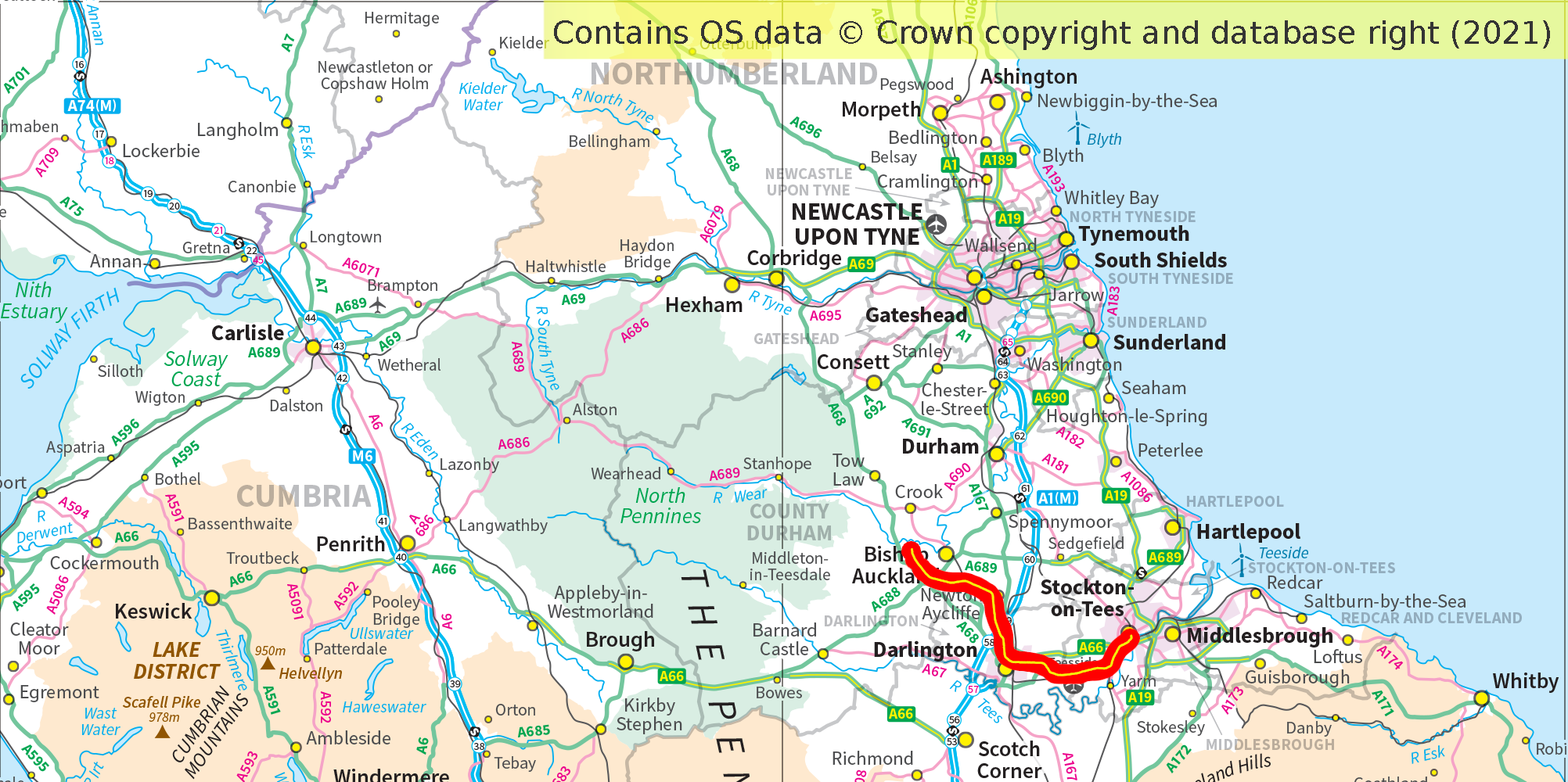
- Base map: OS Data Crown © copyright and database right 2021
- Map route: © AngelaMcAngela 2021
- Youtube: Shildon Telly – The Story of the Brusselton Incline
- Youtube: The Railway Station – Lockdown Lecture 2 What Survives of the S&DR We created the route by tracing landscape scars found on the Ordnance Survey 1:10000 scale maps. A couple of Youtube video documentaries guided the analysis. Finally, we scaled the resultant route to fit the base map above.